
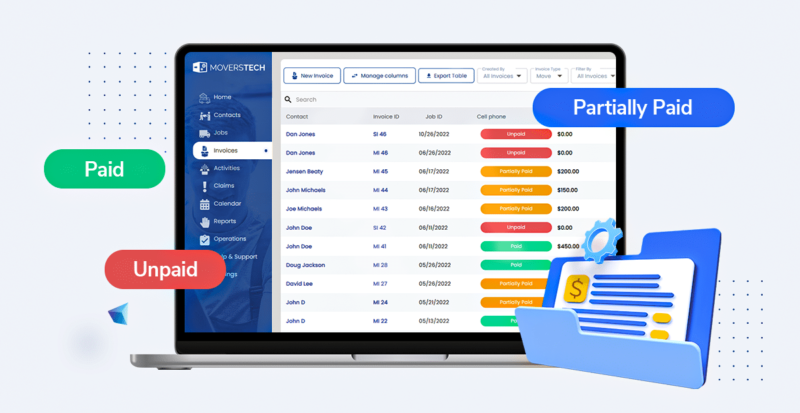
This guide explains the main types of moving quotes, binding, non-binding, not-to-exceed, hourly, and flat-rate, and how each affects pricing and customer expectations. It also covers how online moving calculators and CRM tools help movers improve accuracy, streamline quoting, and deliver transparent, dependable estimates.
Most movers know what a moving quote is. Fewer take full advantage of the fact that they can offer several different kinds — each with its own advantages, trade-offs, and ideal use case. The quote type you choose shapes how much a customer pays, how protected they feel, and how often you end up in a pricing dispute. Here are the five most common types, what each one does well, and how modern movers generate them accurately.
Comparing different types of moving quotes
Offering the right quote lets you give customers accurate, competitive pricing while avoiding unexpected costs. Understanding the benefits and drawbacks of each type — and backing them with a CRM built for moving companies — helps you deliver transparent, dependable estimates and stand out in a competitive market.
| Quote type | Price certainty | Best for |
|---|---|---|
| Binding | Fixed — won’t change | Customers who want total certainty |
| Non-binding | Estimate — may go up or down | Flexible jobs where scope isn’t final |
| Not-to-exceed | Capped — never pay more | Building trust and avoiding disputes |
| Hourly rate | Depends on time on the job | Local moves |
| Flat rate | Fixed regardless of time/distance | Long-distance moves |
Binding estimates
A binding quote gives your customer a fixed price that won’t change. It’s the strongest reassurance you can offer: the number on the estimate is the number they pay, with no unexpected costs on moving day. The trade-off is on you — if the job runs longer or larger than expected, you absorb the difference, so binding quotes depend on getting the estimate right up front.
Non-binding estimates
A non-binding quote gives customers an approximate cost rather than a guaranteed one. The final price can come in higher or lower based on the actual weight, time, or services the move requires. It suits customers who are comfortable with some variability — but it needs clear communication, because a final bill that’s higher than the estimate is a common source of disputes. Tightening your estimate process is the best way to improve quote accuracy and reduce disputes.
Not-to-exceed estimates
A not-to-exceed quote sets a ceiling: you estimate the cost, but the customer never pays more than the agreed maximum. If the move comes in under, they pay less. It gives customers price protection and, because it removes the fear of a surprise bill, it builds trust and reduces pricing disputes.
Hourly rate quotes
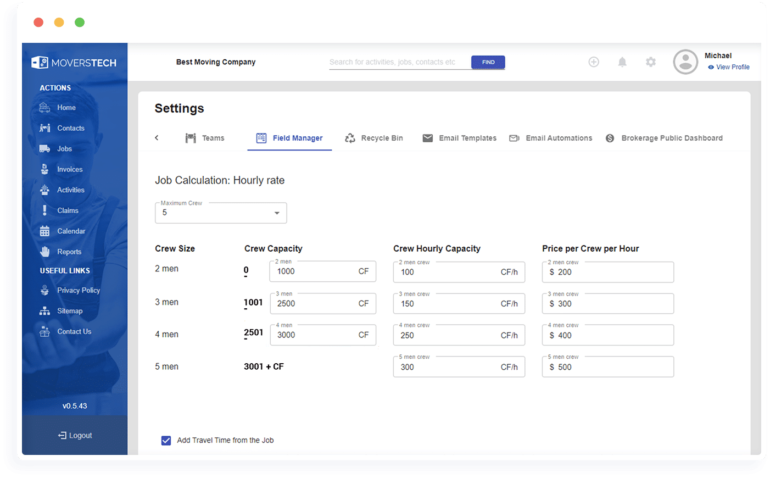
Hourly rate quotes are popular for local moves. You charge for the time your crew spends packing, loading, and unloading, so the final cost depends on how long the job takes. The accuracy challenge is predicting those hours before the truck rolls — which is exactly where pricing automation, and increasingly AI-assisted estimates, have changed how movers quote (more on that below).
Flat rate quotes
A flat rate quote gives a single fixed price regardless of how long the move takes or how many miles it covers. It’s popular for long-distance moves, where it offers customers peace of mind that unforeseen circumstances won’t change the final cost.
How movers build these quotes today
Knowing the quote types is one thing; producing them accurately, fast, and consistently is another. In 2026, most growing moving companies have moved past spreadsheets and memory and rely on a moving CRM to automate their pricing. Here’s what that looks like in practice with a system like MoversTech.
- Tariff-based pricing that applies the right rate automatically. Instead of pricing each job by hand, you set up tariffs for different scenarios — by branch, job type, date, mileage range, and pricing type. When a job is created or updated, the system applies the correct tariff automatically based on the conditions you set. If more than one tariff matches, priority rules decide which wins, so the right rate is applied every time without manual selection. That flexibility matters because rigid pricing rules carry a hidden cost as your operation grows.
- An hourly engine built for local-move accuracy. For hourly quotes specifically, the system calculates the pricing structure from the move size, using settings you control: crew speed, volume or weight limits per crew size, truck capacity, minimum hours, and hourly rates that can vary by day of the week. That turns “how many hours will this take?” from a guess into a calculation — directly improving the accuracy of the hourly quotes that are hardest to estimate.
- Charges and rounding that keep the final number clean. Tariffs can automatically include extra charges, discounts, taxes, valuations, and materials. Extra charges can be calculated by percentage, weight, mile, or volume, and labor hours round automatically to 15-minute increments — so the estimate a customer signs and the invoice they receive line up.
- Quotes customers can review and sign. Once the price is set, the quote goes out as a document the customer can fill and sign — with checkboxes to select options like insurance or packing, and e-signature built in. The quote becomes a booked job in the same system, with no re-entry, which is part of why editable contracts speed up booking.
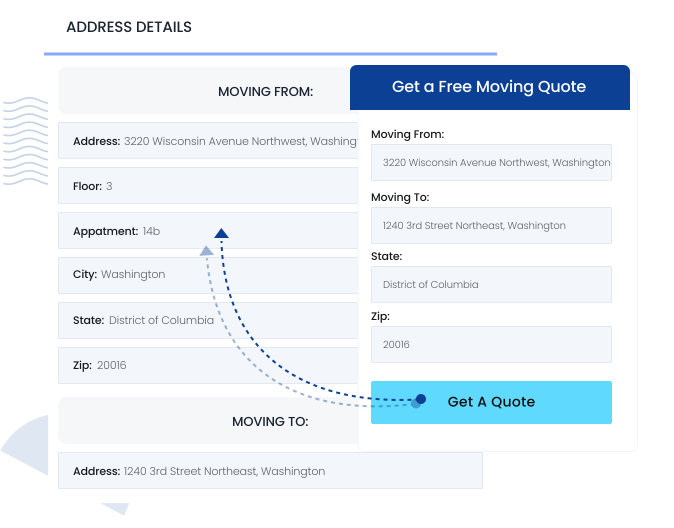
- Using online moving calculators for accurate quotes. An online calculator on your website gives potential customers a quick, convenient way to get a free, accurate quote — which increases leads and conversions while improving customer satisfaction through transparent, upfront pricing. There’s a real opportunity to grow your business with a quote calculator, and it saves your team time by automating the quoting process and reducing manual calculations.
The real advantage comes when that calculator feeds into your CRM. With a moving CRM, leads and the quotes attached to them are tracked and managed in one place — invaluable when you’re handling a high volume of estimates, and one of the most effective ways to perfect online estimates with moving software. The CRM also lets you track and analyze your quoting process over time, so you can see which quote types convert, where estimates drift from final costs, and how to keep improving accuracy.
Maximize your moving company’s potential with accurate quoting
Offering the right mix of quote types — and backing them with a CRM that automates the pricing behind them — delivers measurable benefits:
- Higher customer satisfaction through flexible, transparent estimate options
- A faster, more consistent quoting process that saves time
- More accurate quotes, with fewer errors, surprises, and disputes
- Better lead management and clearer insight into how your quoting performs over time
Accurate quoting isn’t just about winning the job — it’s about protecting the margin on every move you book, and it’s how some movers are cutting quote-to-payment time in half. See how MoversTech automates pricing from the first estimate to the signed contract.
Frequently Asked Questions
What are the main types of moving quotes?

The main types of moving quotes are binding estimates, non-binding estimates, not-to-exceed estimates, hourly rate quotes, and flat-rate quotes. Each option affects pricing, accuracy, and how much a customer may pay at the end of the move.
What is the difference between binding and non-binding moving quotes?
A binding moving quote offers a fixed, guaranteed price that won't change. A non-binding quote is an estimate that may increase or decrease based on the actual weight, time, or services required during the move.
Why do movers use not-to-exceed quotes?
Movers use not-to-exceed quotes to give customers price protection. If the final cost is lower than estimated, the customer pays less - but they never pay more than the agreed maximum. This option builds trust and reduces pricing disputes.
How can moving companies create more accurate moving quotes?
Accurate quotes come from clear itemization, proper measurements, and consistent workflows. Tools like online moving calculators and CRM-based quoting help movers automate calculations, reduce manual errors, and offer transparent pricing for every move.
Reviewed by: Ned Bjelos
